Navigating the complex world of education financing can be daunting for students and parents alike. Understanding the current landscape of student loans is crucial for making informed decisions about your educational future.
With the rising costs of higher education, many students find that their financial aid package doesn’t cover all expenses, making private student loans a necessary consideration. However, it’s essential to exhaust federal loan options first, as they typically offer lower interest rates.
This comprehensive guide will explore the latest interest rates, repayment terms, and options available for both federal and private loans in the present market, helping you secure the most favorable loan terms based on your credit profile and financial situation.
Understanding Student Loans in the US
As the cost of attending college continues to rise, understanding the role of student loans becomes essential for prospective students. The financial burden of higher education is a significant concern for many families.
What Are Student Loans?
Student loans are financial aid packages designed to help students cover the costs associated with higher education. These loans can be used to pay for various educational expenses, including tuition, fees, books, and living expenses. The funds from these loans can be utilized for any school costs included in the college’s cost of attendance (COA) for the year.
Why Student Loans Are Necessary
The rising cost of college education in the US has outpaced inflation and wage growth, making it increasingly difficult for families to pay for higher education out of pocket. According to recent data, the average annual cost of attendance at four-year institutions continues to climb, creating a significant financial gap that many students can only bridge through loans. While scholarships and grants are preferable funding sources, they rarely cover the entire cost of education, making student loans a necessary component of most students’ financial aid packages.
For many career paths requiring specialized degrees, the return on investment justifies taking on reasonable student loan debt to achieve higher lifetime earnings potential. Thus, understanding the nuances of student loans, including interest rates and repayment options, is crucial for making informed decisions about financing one’s education.
Federal vs. Private Student Loans
When it comes to financing education, students in the US have two primary options: federal student loans and private student loans. Understanding the differences between these two types of loans is crucial for making informed decisions about how to fund higher education.
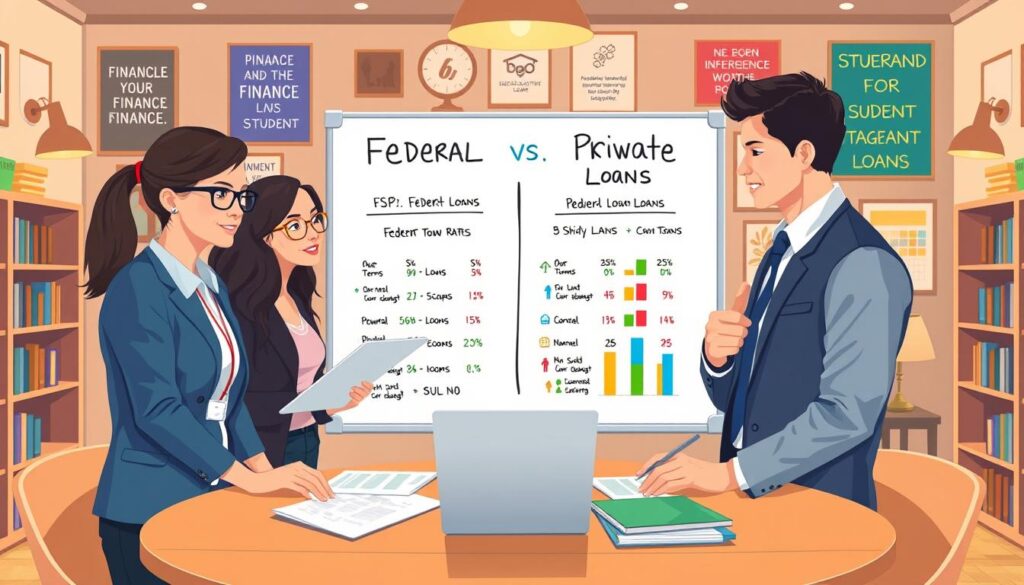
Federal Student Loan Options
Federal student loans are provided by the government, offering several benefits, including lower interest rates and more flexible repayment options. These loans are often subsidized, meaning the government pays the interest while the student is in school. Federal loans also offer income-driven repayment plans and Public Service Loan Forgiveness (PSLF) programs, making them an attractive option for many students.
According to expert analysis, “federal student loans provide a safety net for students, offering affordable financing options with favorable terms.” The application process for federal loans typically involves completing the Free Application for Federal Student Aid (FAFSA), which determines eligibility for federal, state, and institutional financial aid.
Private Student Loan Basics
Private student loans, on the other hand, are offered by banks, credit unions, and other financial institutions. Unlike federal loans, private loans are credit-based, meaning that the borrower’s creditworthiness and that of their cosigner (if applicable) play a significant role in determining the loan’s interest rate and terms. Private loans can be used to supplement federal aid when necessary, helping students cover the full cost of attendance.
As noted by financial experts, “private student loans can provide a vital source of funding for students who have exhausted federal loan options or need additional financing.” Private lenders often offer both fixed and variable interest rates, and some provide benefits like interest rate discounts for automatic payments and cosigner release options after a certain number of on-time payments.
In conclusion, while both federal and private student loans have their place in financing higher education, understanding their differences is key to making the right choice. By considering factors like interest rates, repayment terms, and borrower benefits, students can make informed decisions about their loan options.
Current Student Loan Interest Rates
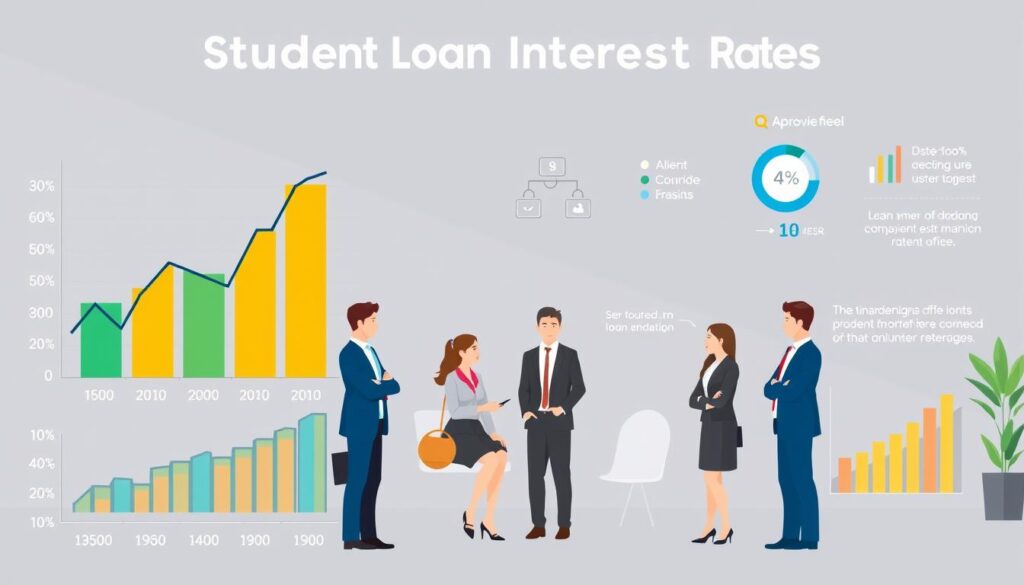
Understanding the current interest rates for student loans is crucial for making informed decisions about borrowing for higher education. The interest rate on a student loan determines how much extra you’ll pay beyond the principal amount borrowed.
Fixed vs. Variable Interest Rates
Student loans can have either fixed or variable interest rates. A fixed interest rate remains the same throughout the life of the loan, providing predictable monthly payments. In contrast, a variable interest rate can fluctuate based on market conditions, potentially leading to higher or lower monthly payments over time.
When choosing between fixed and variable rates, consider your financial situation and risk tolerance. If you prefer stability, a fixed rate might be more suitable. However, if you’re comfortable with the possibility of rate changes, a variable rate could potentially save you money if rates decrease.
How Interest Rates Impact Total Loan Cost
The interest rate on your student loan significantly impacts the total cost of the loan. Even small differences in interest rates can result in thousands of dollars in additional costs or savings over the life of the loan.
- For example, a $30,000 loan at 4% interest versus 6% interest over a 10-year term results in approximately $3,600 in additional interest payments.
- Interest begins accruing immediately on most student loans, and unpaid interest may capitalize, compounding the cost.
- Borrowers should use loan calculators to compare different interest rate scenarios and understand how their choice of repayment plan affects the total amount paid.
- Strategic approaches to managing interest costs include making payments while in school and refinancing to a lower rate when credit and income improve.
Before borrowing, students should use Finaid’s Loan Payment Calculator to get a clear picture of what repayment will look like after graduation. This helps potential borrowers make more informed decisions on how much to borrow and the impacts of different interest rates.
Private Student Loan Providers

The landscape of private student loan providers is diverse, with numerous lenders offering varying terms and benefits. When comparing these providers, it’s essential to look beyond just the interest rates to evaluate the full package of benefits and features that can significantly impact the loan experience.
Top Lenders in 2023
In 2023, several private student loan lenders stood out for their competitive offerings. Lenders such as Sallie Mae, Discover, and Citizens Bank were among those recognized for their favorable terms and borrower benefits. For instance, Sallie Mae offers a 0.25 percentage point interest rate reduction for borrowers who enroll in auto debit, which can lead to significant savings over the life of the loan.
Other top lenders have also introduced innovative features, such as flexible repayment options and robust borrower protections. When selecting a lender, it’s crucial to consider these aspects to ensure the best fit for your financial situation.
Comparing Lender Benefits and Features
When evaluating private student loan providers, several key factors should be considered. Many lenders offer interest rate reductions for enrolling in automatic payments, loyalty discounts for existing customers, and relationship benefits for maintaining accounts with affiliated institutions. Repayment flexibility varies widely among lenders, with options ranging from in-school payment plans to various term lengths after graduation.
Borrower protections, such as hardship forbearance and death/disability discharge policies, also differ between lenders. Additional features to compare include cosigner release eligibility, graduation rewards, and the quality of customer service and online account management tools. By carefully evaluating these benefits and features, borrowers can make informed decisions that suit their financial needs.
Applying for Student Loans
Navigating the student loan application process can be straightforward with the right guidance. The process involves understanding the requirements and preparing the necessary documentation. By breaking down the application process into manageable steps, students can ensure a smooth experience.
Application Process Step-by-Step
The first step in applying for a loan is to determine the type of loan needed, whether it’s a federal or private student loan. For federal loans, students must complete the Free Application for Federal Student Aid (FAFSA), which assesses their eligibility for financial aid. This step is crucial as it determines the amount of aid a student is eligible for.
Once the FAFSA is submitted, students should review and compare the loan offers from different lenders, considering factors such as interest rates and repayment terms. It’s also essential to understand the role of a cosigner, as having one with a good credit score can significantly impact the loan’s terms.
Required Documentation and Eligibility
To apply for a student loan, students must gather various documents, including proof of identity, income information, and details about their school enrollment. For federal loans, this includes the completed FAFSA, Social Security number, and tax returns. Private lenders may require additional documentation, such as proof of income for the student or cosigner.
Eligibility criteria vary between federal and private loans, with private lenders often having more stringent requirements, including a good credit score or a creditworthy cosigner. Students attending an accredited school and meeting specific academic standards are generally eligible. The image below illustrates the key steps in the application process.
Understanding these requirements and preparing the necessary documents can streamline the application process. By carefully reviewing the eligibility criteria and required documentation, students can ensure they are well-prepared to apply for the loan that best suits their needs.
The Role of Cosigners in Student Loans
A cosigner can be a game-changer for students looking to finance their education through private student loans. By having a creditworthy cosigner, typically a parent or guardian, students can qualify for more favorable loan terms, including lower interest rates and higher loan amounts.

Benefits of Having a Cosigner
Having a cosigner can significantly benefit students by helping them secure better loan conditions. The primary advantages include:
- Lower interest rates due to the cosigner’s good credit history, potentially leading to an interest rate reduction.
- Increased loan amounts, enabling students to cover more of their educational expenses.
- Better approval chances, as the lender considers the cosigner’s creditworthiness.
This can lead to more manageable monthly payments and a more stable financial situation for students.
Cosigner Release Options
Many lenders offer cosigner release options after a certain period of on-time payments, typically ranging from 12 to 48 months. To qualify, borrowers usually must demonstrate financial stability, including sufficient income and a good credit score, often above 670.
The process involves submitting financial documentation and undergoing a credit check. If approved, the cosigner is released from their obligation, relieving them of responsibility for the loan. Alternatively, borrowers can consider refinancing the loan in their name alone if they now qualify independently, potentially achieving a rate reduction.
Student Loan Repayment Options

The journey to repaying student loans begins with understanding the repayment options available. Borrowers have various plans to choose from, depending on their financial situation and loan type.
In-School Repayment Choices
While still in school, borrowers may have the option to make interest-only payments or defer payments altogether. The Graduation Repayment Program (GRP) allows for interest-only payments for the initial 12-month period after the loan would normally begin requiring full principal and interest payments. This can provide temporary relief, but it’s essential to note that the total loan cost may increase after GRP ends.
Understanding the implications of GRP and other in-school repayment choices is vital. Borrowers should consider their financial situation and the terms of their loan to make informed decisions.
Post-Graduation Repayment Plans
After graduation, borrowers face a range of repayment plan options that vary significantly between federal and private loans. Federal loans often offer more flexibility and income-based options. Standard repayment plans feature fixed monthly payments over a 10-year term, providing predictable obligations and the lowest total interest cost.
Other options include graduated repayment plans, which start with lower monthly payments that increase every two years, and extended repayment plans, which stretch payments over 15-25 years, reducing monthly obligations but increasing total interest paid. Income-driven repayment plans tie monthly payments to the borrower’s discretionary income, offering affordability for lower-income graduates.
Choosing the right repayment plan is crucial. Borrowers should consider their financial situation, career prospects, and the terms of their loan to select the most appropriate plan.
Factors to Consider When Choosing a Student Loan
Selecting a student loan that aligns with your financial situation and goals requires careful consideration of several key elements. When evaluating student loan options, it’s essential to look beyond the loan amount and consider the terms and conditions that will impact your financial future.
Interest Rates and Fees
One of the most critical factors to consider is the interest rate associated with your student loan. Interest rates can significantly affect the total cost of your loan, with higher rates resulting in more substantial repayment amounts over the loan term. Additionally, be aware of any fees associated with the loan, such as origination fees, late payment fees, or prepayment penalties. For instance, a $10,000 loan with a higher interest rate could end up costing much more than the same loan amount with a lower rate.
Repayment Flexibility
Repayment flexibility is another crucial aspect to consider when choosing a student loan. Look for lenders that offer flexible repayment plans, including options for deferment or forbearance if needed. Some lenders provide income-driven repayment plans that can adjust your monthly payments based on your income level. This flexibility can be particularly helpful during the initial post-graduation period when income may be limited.
Borrower Benefits and Discounts
Many lenders offer borrower benefits and discounts that can reduce the overall cost of your loan. For example, enrolling in auto-debit through lenders like Sallie Mae can result in an interest rate reduction of 0.25 percentage points. Other benefits may include loyalty discounts for existing customers, graduation rewards for completing your degree, and on-time payment rewards for consistent payments. Some lenders also offer career support services to help borrowers maximize their post-graduation earning potential.
Conclusion: Making the Right Student Loan Decision
Making the right student loan decision requires a comprehensive approach that balances immediate affordability with long-term financial implications, considering your specific educational goals and career prospects. To achieve this, start by maximizing free money such as scholarships and grants, and federal student loans before turning to private student loans.
When comparing loan options, it’s crucial to look beyond the interest rate and evaluate the full package of terms, including fees, repayment flexibility, and borrower benefits. Consider your future income potential in your chosen field of study when determining an appropriate loan amount. A general guideline is to keep total student loan debt below your expected first-year salary after graduation.
Using loan comparison tools can help create side-by-side evaluations of different loan options. Remember, today’s decision about student loans will impact your financial life for years to come, affecting your ability to save for other goals. Review the fine print carefully, particularly regarding how interest accrues and what happens if you need to pause payments.